Hello
The POH of my flying club’s Cessna 172 advices of the following in case of a water landing:
“If no power is available, approach at 70 KIAS with Flaps UP or at 65 KIAS with Flaps 10°.”
also:
“9. Touchdown LEVEL ATTITUDE AT ESTABLISHED RATE OF DESCENT”
That seems quite fast for touching down. I would assume that it would be safer to touch down closer to stall speed (say 55 kts flaps down). What are your thoughts on that?
Merry Christmas
/Christian
I think the physics of water landings are too complex to give definitive answers, but some things are universal – slower means less energy to dissipate. Assume you will flip over, and have a plan to get out. If you are in RG aircraft, conventional wisdom is to leave the gear up. Flaps up or down is still up for debate. Doors open/unlatched seems like a wise choice. For those with slider canopies – get ready for a battle to get out. Obviously don’t inflate the life vest until you get out of the aircraft.
In case of ditching in my C172:
Yes I would follow a similar procedure. So I would say 65 to 70 kts would be too fast. I am puzzled as to why the POH recommends this speed…
If power out, you need some energy to hold off and flair, without ditching tail first – also judging height in a ditching will require some hold off.
Conversely rounding out at 50 KIAS, full flap, risks stalling in i.e. nose first!
Agreed. I think the poh is saying to Approach at those speeds, not to touch down at that speed.
AfricanEagle wrote:
align with waves
Better, much better, will be to align with any swells. If waves are big enough that you think to align with them, you’re in big trouble no matter what you do! Landing into the waves generally means that you’re also landing into the wind, which is very desirable. Ignoring swell direction, while thinking only of the waves will end poorly. Think of trying to land on a runway whose elevation changes many feet every 50 to 200 feet. If landing aligned with the swells requires a crosswind landing, then do that. You can aim to land across the crest of a swell, then allow the airplane to drop into the trough as it slows.
For the purpose of landing on it, think of water as a solid. Yes, it’s going to absorb the plane, but the initial contact will be solid. This is one of several reasons that a ditching should be planned as a controlled landing to a firm surface, rather than thinking to drop in as jumping into water – that’s different. Another reason will be that until very experienced, judging the height for a good flare will be much more difficult, or 100% impossible, if the water is glassy, and perhaps very clear. You want to contact the water in controlled flight, and able to apply the last bit of up elevator as you contact. Touching down very nose high will just slap the plane down with no benefit at all. You’re going in, and you’re probably going to flip if it’s a fixed gear wheelplane, so you may as well have as much control as possible. Some wise pilot once said to fly the airplane as far into the crash as possible.
In airplanes with very effective flaps (most 100 series Cessnas) full flap pitches the airplane down noticeably, and reduces the elevator effectiveness to hold the nose well high at slow speeds. Indeed, which some float installations on Cessnas, the flaps travel is restricted from 40 to 30 for this reason – power off, there is not enough nose up control for a safe water landing under any conditions. Better to use mid flap, rather than full flap, unless you’re really practiced at power off landings with full flap, and judging flare height with no runway visual reference.
If you maintain a decent approach speed, it will allow for last minute refinement of your flare. Presuming that ditching distance is not a concern, you should be able to stretch out your touchdown spot if you’ve judged your speed too fast, just stretch out your flare.
If you can, move anything in the cabin as far aft as possible, an aft C of G will help you.
Put on the lifejacket that you wisely brought along for your over water flight. You cannot practically put it on in the water. If you have passengers, assure theirs are on too. Each of you could help an unconscious other by simply pulling the inflate tab, to keep them floating while you take stock of the situation. Know how you would manually inflate the lifejacket – I had to, I did not realize at the time that my left arm was broken, so I could not use it to pull the tab, while I held on the sinking plane with my other hand. I got it inflated by mouth.
Put your cell phone in the waterproof bag you wisely brought for that purpose. It’s useless to summon help once it’s wet in your pocket. (My cell phone lasted for three days in it’s waterproof bag at the bottom of the lake, while my wife continued to call it out of curiosity) – she knew where I was, the phone was never found. Put absolutely everything you might want out of the plane in your pockets, ‘cause you’re not getting that item out after the ditching, you’ll be busy just getting yourself and your passengers safely out.
Just prior to touchdown (splash down) consider exactly what action from which hand will unbuckle your seatbelt, and assure that the buckle is not obscured by loose clothing. Once in the water, before opening your seatbelt, assure that the door will open, and you have an plan (your orientation in the cabin) to exit. Please one hand on the structure you’re going to pull yourself out with, then using the other hand as planned, open your seatbelt, and pull yourself out without letting go of the structure, so you keep yourself oriented. If you find yourself trapped inside a single Cessna with a one piece windshield, in most cases kicking it out at the top of the windshield is fairly easy. If you have passengers, push/pull them out first, you can’t go around nor back for them if you get out first.
Take underwater egress training.
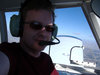
Me in my second underwater egress training, having survived because of the first training….


Pilot_DAR wrote:
Put on the lifejacket that you wisely brought along for your over water flight. You cannot practically put it on in the water. If you have passengers, assure theirs are on too
The lifejacket should be on before the flight. When you need it, it is too late.
pull yourself out without letting go of the structure, so you keep yourself oriented.
Indeed,. That was one of the main takeaways when I took egress training. Never ever let go of the aircraft structure with both hands Always hold onto something with one hand and know what you’re going to hold on with the other hand.
Airborne_Again wrote:
The lifejacket should be on before the flight.
To make this a reality, use a comfortable wearable one, not the basic ones wrapped in plastic. Just make sure they are manual trigger, not automatic trigger.
That

Not this

This video is illustrative of the flaps-up approach, pun intended